+

A designer who makes complex systems feel obvious.

I'm Robert Van Liew, a product designer who also writes the code and owns the semantic architecture. I specialize in end-to-end experiences for financial products and SaaS platforms, using motion and transitions to make complex workflows feel cohesive. I take designs from low-fidelity flows all the way to production deployment, with a focus on interaction craft and accessibility. My work is grounded in building tools across finance and consumer experiences that reduce friction and increase confidence in how people think, decide, and feel when using products.

Based
New York, NY
Discipline
Product Design · Interaction Design · Front-End
Status
Open to new opportunities
Tools
Figma · Semantic HTML · Modern CSS (Grid, Custom Properties, :focus-visible) · React · TypeScript · Tailwind · Schema.org · Claude · Gemini
Strengths
Fintech SaaS · Ecosystem Patterns · Systems Thinking
Practice
WCAG Accessibility · Semantic UI · Information Architecture

Work, filed under things I'm proud of.

smartdeductions.app
Tax Profile & Preferences
Configure your business entity to improve deduction engine accuracy.
Business Entity Structure
Sole Proprietor
Gig worker or freelancer without formal incorporation.
Single-Member LLC
Registered LLC defaulting to pass-through taxation.
S-Corporation
Corporate tax structure with payroll requirements.
Ecosystem Integration: This entity selection automatically configures which tax filing format best fits your needs (Self-Employed vs Business Schedule C).
Cancel
Save Profile
EXPENSE BREAKDOWN
Top Categories
TOTAL OUTPUT
$1,397.76
Insurance
Utilities
Shopping
Groceries
Other
Dining

Financial SaaS: Smart Deductions

Systems thinking  ·  Fintech dashboards  ·  Data fluency  ·  Local-first architecture

Sole designer and engineer on Smart Deductions, a local-first expense tracker for LLC owners and 1099 contractors. Drop in any PDF bank statement and get an IRS-ready, auto-categorized CSV export in under 5 seconds. Zero servers. Zero accounts. Complete privacy. Designed and built end-to-end with 9 Schedule C categories, dual chart views, and a command palette.

Jersey Club Radio logo

Jersey Club Radio

UX/UI design  ·  Wireframing  ·  Audio streaming  ·  React · Next.js

Sole designer and engineer on a 24/7 live radio streaming platform for Jersey Club music. From hand sketches and Figma wireframes to a production Beta. Persistent mini-player, animated waveform, accessible playlist, and a WCAG-accessible dark UI. Three months in development, currently live in Beta.

NYC · Violinist · Producer
Julie
Schatz
Weddings · Private Events · Corporate Galas
View Case Study →

Julie Schatz Music

Editorial design  ·  SEO & schema  ·  Booking flow  ·  Local-first state

Two-week rebuild of a NYC wedding musician site. Started from a placeholder domain with no design, no SEO, and no booking flow. Shipped an editorial visual system, a deep schema build covering LocalBusiness, MusicGroup, Events, Reviews, and FAQ, and a ceremony picker that drafts across pages into the booking form so couples arrive at the inquiry with their music already chosen.

DMC Canada desktop and mobile mockup

DMC Canada '26

UI/UX design  ·  Full-stack dev  ·  E-commerce  ·  Motion design

Sole designer and developer for the Canadian division of the DMC World DJ Championships. Built and shipped in a 1-week sprint. Designed the full brand system, purposeful micro-interactions, and e-commerce flow, then engineered it to production using React, Next.js, and Stripe.

Systems & Craft.

Demonstrating scalable design tokens and accessible component architecture built for enterprise environments.

Design Tokens

Thematic Scalability

Built entirely on CSS root variables, so the UI adapts to different product ecosystems without altering the underlying markup. Try swapping the ecosystem theme in the top navigation bar.

DateDescriptionAmount
Mobile View$42.62
Collapses gracefully via CSS Flex/Grid
Graceful Degradation

Responsive Architecture

Components are engineered to adapt flawlessly across viewports. For example, complex data tables collapse into highly legible mobile cards using modern CSS flex and grid logic, ensuring the Shared Experiences team can deploy once and run anywhere.

Before · WCAG fail
Secondary label
Ratio 2.8:1
After · AA pass
Secondary label
Ratio 6.1:1
Accessibility Audit

WCAG by Design

Every interactive component is audited against WCAG 2.1 AA. Contrast ratios are tested at both default and hover states. Focus rings use :focus-visible with a 3px offset to avoid false positives on mouse users. Motion is wrapped in prefers-reduced-motion, not as an afterthought, but as a first-class token applied globally. These aren't retrofits; they're baked into the design system from the first commit.

julieschatzmusic.com · JSON-LD graph
@type: LocalBusiness #business
@type: MusicGroup #business
@type: Person #julie
@type: Service × 8 provider → #business
@type: Event × 14 performer → #julie
@type: Review × 10 + AggregateRating itemReviewed → #business
SEO & Structured Data

Discoverable by Design

Search visibility is a design surface, not an afterthought. The Julie Schatz site carries 17 JSON-LD blocks wired together through @id references, so Google reads one connected entity instead of seventeen disconnected ones. LocalBusiness and MusicGroup share an identity. Eight Service entries point back to the business. Fourteen Event entries point to the Person. Ten Reviews drive an AggregateRating computed from real counts, never fabricated. Schema markup is a contract with the search engine, and treating it like a token system means the contract holds at scale.

Schedule C · category tokens
--cat-subscriptions#a78bfa
--cat-utilities#4fc3f7
--cat-shopping#818cf8
--cat-groceries#34d399
--cat-dining#ff6b7a
--cat-insurance#fb923c
Semantic Color Tokens

Color = Category. Always.

The Schedule C category colors are a design system, not a theme. Each token is referenced exactly once, in the token file, and consumed across the donut chart, bar chart, transaction badge, CSV export column header, and tooltip. "Purple always means Subscriptions" becomes internalized within a single session. This is the color-as-grammar pattern QBO uses across its own reporting surfaces.

Motion tokens · ease-fluid
--dur-micro 150ms
--dur-macro 250ms
--dur-stage 400ms
--ease-fluid
cubic-bezier(.22,.68,0,1)
Motion System

Named Easing, Purposeful Duration

Three duration tokens: micro (hover lifts), macro (card transitions), staging (staggered entrances), share one named easing curve: ease-fluid (cubic-bezier(.22,.68,0,1)). It produces a snappy initial response with a soft settle, avoiding the mechanical feel of ease-in-out. All motion is wrapped in prefers-reduced-motion: reduce at the token level, so no individual component needs to handle it.

Cross-surface draft · ceremony picker
01 /wedding-ceremony-songs/ · pick
localStorage · julieschatz.ceremony.v1
02 / · inquiry drawer · surface
03 capture-phase submit · attach
04 success only · clear
Local-First State

State without a Server

Draft work should follow the user across pages without requiring an account, a sync layer, or a database round-trip. On julieschatzmusic.com a couple builds their ceremony song selections on one page and the draft surfaces inside the booking form on any other page through one namespaced localStorage key. A MutationObserver watches the inquiry drawer for the active state, reads the draft, and renders it inline. A capture-phase submit listener serializes the draft into a hidden field before the form handler reads FormData. The draft only clears on confirmed submission success, so validation errors, network failures, and disposable-email rejections all leave the work intact. The pattern generalizes to any flow where the cost of losing user input is higher than the cost of carrying it.

/ DMC Canada '26

DMC Canada '26

UI/UX Design Full-Stack Dev E-Commerce
Sole designer and developer for the Canadian division of the DMC World DJ Championships. Designed and shipped a full platform. Brand system, ticketing, merchandise, and event info, in a 1-week sprint. Every interaction, transition, and checkout flow was both designed and built by hand, from Figma to production.
Role
Designer · Lead Engineer
Partners
Event producer (requirements + brand approval) · DMC Canada organizer (stakeholder review)
Stack
React · Next.js · Stripe · Tailwind
Timeline
1 Week Sprint
Year
2026
dmcdjcanada.com
Desktop · live site scroll · dmcdjcanada.com

Fragmented Legacy Platform

The DMC World DJ Championships needed a full digital overhaul for their Canadian division. The legacy system was fragmented and didn't perform well on mobile devices, leading to cart abandonment during high-traffic ticket drops. The goal was to unify the brand and checkout experience into a single, highly performant web app.

Dark-Themed, Competition-Ready UI

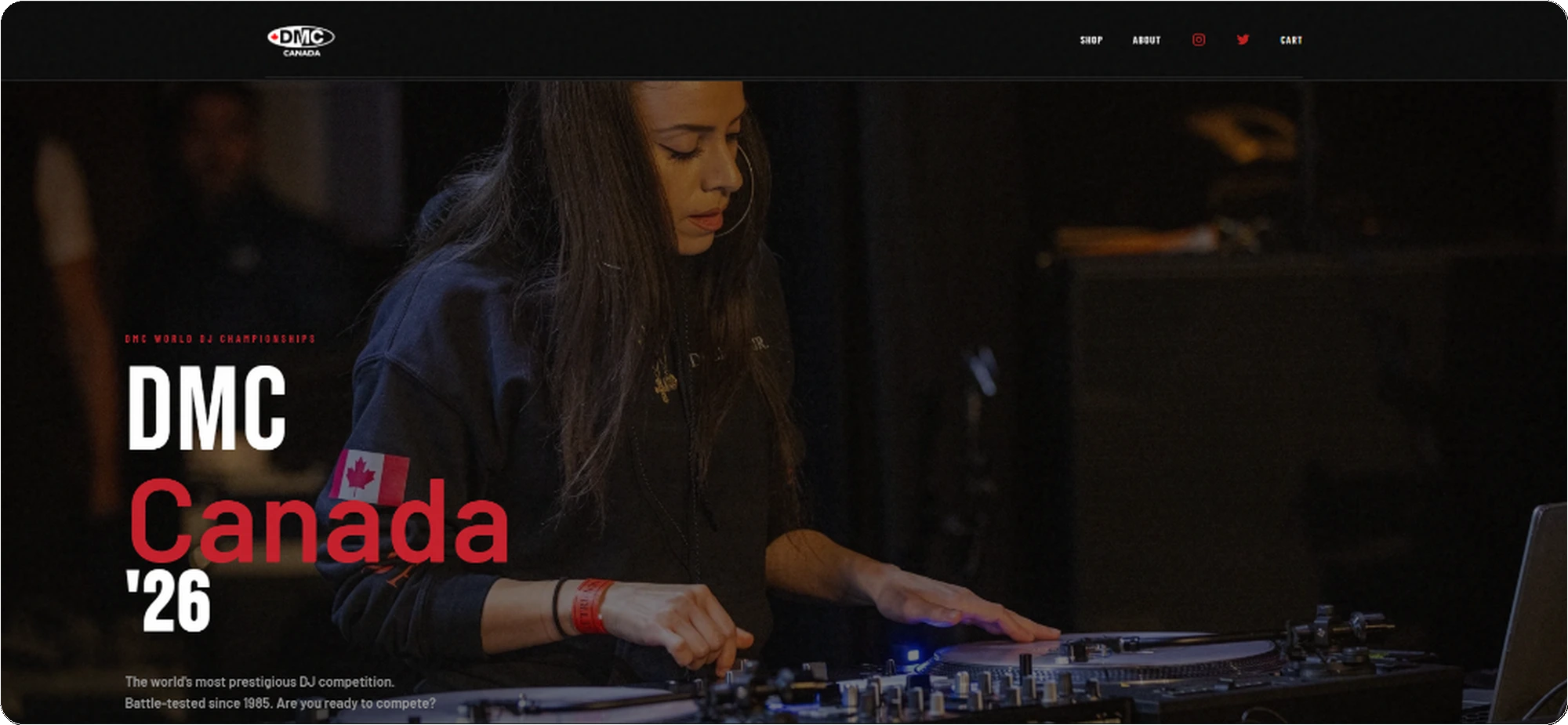
I architected a dark-themed, glassmorphic UI system utilizing stark red contrasts to evoke a sense of competition and energy. Bold typography and full-bleed imagery set the tone for an event that's all about performance and precision.

Mobile · responsive scroll · hover to preview

Friction-Free Purchase Funnel

To solve the conversion issues, I rebuilt the entire e-commerce flow with emphasis on native mobile UX principles. Key touch targets were enlarged, complex forms were broken into step-by-step interactions, and Apple Pay / Google Pay were integrated deeply into the checkout drawer. The result significantly reduced cart abandonment.

DMC Canada desktop view
Desktop · full event page with ticketing
DMC Canada mobile view
Mobile · optimized checkout flow

Migrating to Stripe for Resilience

To handle high-traffic ticket drops, I migrated the payment infrastructure to Stripe. The payment flow was restructured to preempt errors: inline zip code validation prevents late-stage declines, and explicit error states guide users through card rejections without clearing their cart. By integrating Apple Pay and Google Pay directly into a persistent checkout drawer, the number of required tap interactions was dramatically reduced, directly increasing conversion rates and mitigating cart abandonment.

Sprint Results

Delivered under a hard event deadline. Stakeholder sign-off in a single design review. No revision rounds on visual direction.

Sprint Duration
6 days
Figma to production deploy
Lighthouse Score
94 / 100
Performance · Accessibility 100
Revision Rounds
0
Stakeholder sign-off in first review

Unified Brand + Commerce Platform

The final platform integrates ticketing, official merchandise, event information, and competitor registration under a single dark-themed brand system. Every element, from hover states to micro-interactions, was designed to feel cohesive, premium, and razor-sharp for an event built on precision.

Say hello, the tab is open.

Drop a note any time. I usually write back within a day or two, slower when the weather's nice.